
Frequently Asked Questions
To serve you better, we've assembled a list of our customers' most frequently asked questions. If you don't find your answer here, feel free to contact us.
As water turns to ice, it expands. Inside closed pipes it can build up hundreds of pounds per square inch of pressure easily able to burst hoses and split pipes. Here are some tips to prevent damaged plumbing, leaks, and high water bills when the temperature drops.
1. If possible, drain any above-ground piping and hoses for the winter.
2. Wrap undrained faucets and pipes that will be exposed to freezing temperatures with fiberglass or foam insulation. Use of plug-in electric heating wraps is a superior option. This includes pipes in unheated attics and crawl spaces, as well as those outdoors.
3. Crack open the faucets on pipes exposed to freezing temperatures so that they drip. This keeps pressure from building up if some ice does form inside in the pipe.
4. Pipes underground are less likely to freeze, but can still burst if the temperature stays below freezing for several days. Consider draining or protecting them as appropriate.
5. Replace missing trailer skirting and seal any openings where wind can blow into crawlspaces under homes.
6. If a property is going to be unoccupied for a week or more during the winter, and especially if the heat is to be cut off, it is a good idea to have the water shut off at the meter so that any leak will not run for days undetected.
7. Please call the NLWA office if you need the water shut off or if you see a suspected leak on our system. There is no charge to turn off the water in an emergency.
Members are responsible for maintenance of the lines from the water meter to their homes, and for any damage or repairs of these lines.
If NLWA personnel happen to see signs of a leak at a served property such as a spinning water meter or evidence of flooding, and they cannot find anyone there to alert, our policy is to shut off the water at the meter and leave a note on the door. The intent of this policy is to prevent damage and high water bills for homes that are unoccupied. Each year we have several customers with very high water bills due to leaks that run for days or weeks.
If you come home to find your water has been shut off, please check for signs of a leak. If it happens to be nothing more than a running toilet, we hope you will be tolerant of the inconvenience and realize the intent was to be helpful. Call us and we will turn the water back on without a service call charge.
Update: As of fall of 2022, NLWA has suspended fluoridation due to disruptions in supply and skyrocketing prices. Chemical prices in general have nearly doubled and the only supplies of bulk Fluoride currently available are from China and Belgium at triple price. The MS Department of Health has permitted all water systems to similarly suspend fluoridation for these reasons.
--------------------------------
NLWA adds fluoride to its drinking water as recommended by Title 15 Mississippi Administrative Code § 20-17-3. It's primary benefit is to help teeth become resistant to decay and prevent cavities. It only takes a tiny amount to provide this benefit. The amount we add to the water is approximately 0.7 mg/liter = 0.7 parts-per-million, which is near the lower limit of the recommended range of 0.6-1.2 mg/liter. This is equivalent to about one drop from an eyedropper added to 18,500 gallons of water (a large backyard swimming pool). We test fluoride levels at each treatment plant daily and make monthly reports to the MS State Department of Health.
You can see our annual report on fluoride and all other chemical and contaminant testing here https://10.0.0.106/ccr.
Like every element, compound, mineral, chemical, and supplement, fluoride can be harmful as dosage increases. The Environmental Protection Agency (EPA) has set a maximum contaminant level of 4 mg/liter as the point where long-term exposure to fluoride in drinking water may cause harm to health. This is approximately four times the concentration recommended for dental health benefit.
Brown color in our water system is almost always iron oxide, also known as rust. Dissolved iron is naturally present in our well water, and is harmless. It is also invisible until we add chlorine to the water to disinfect it from other threats such as bacteria. The chlorine oxidizes the dissolved iron into tiny particles of rust, which are visible if the concentration is high enough. Our treatment plants normally filter out 95% of this iron, but if something happens to let 10% through instead of 5%, the water will begin to show some brown color and appear "dingy." Even the tiny amounts of iron that get through settle out as sediment throughout our lines and can be stirred up when there is a leak or repair, causing temporary discolored water. The cure for discolored water is flushing our distribution lines and homes and buildings to clear the iron out the lines. Note that all our pipelines are plastic (PVC, HDPE), and do not rust.
If you see discolored water in your home or business, first check to see if it is only on the hot water side, or is both hot and cold water. If hot only, it is likely rust or sediment from your water heater. See the question in this section about sediment in the hot water lines.
If you received an automated phone, text, or email alert about water line maintenance in your area, this is most likely the cause of the discolored water, and it will be temporary. Try not to use water for several hours after such an alert to avoid pulling discolored water into your home. If discolored water persists, phone the Office at 601-681-6157, and they will send someone to flush the lines near your location. If the dirty water seems confined to your home or business, it may be cleared by using the Home Flushing Procedure.
NLWA adds chlorine to disinfect drinking water per federal and state regulations. The small amount of chlorine dissolved in the water actually has no odor. However, when chlorine contacts organic material like bacteria, mold, or dirt, it breaks this material down into microscopic pieces call disinfection by-products (DBP), and the chlorine itself combines with these pieces into compounds called chloramines. DBP and chloramines do have an odor, and it is the smell people might recognize as a public swimming pool. It's really more an ammonia smell, but most people think of it as chlorine from their experiences using it for cleaning and swimming. If you smell this, it means the chlorine has found something that needs disinfecting, and it is working hard to do its job breaking down that organic material.
Many times customers complain that they get a strong odor of chlorine when they first turn on a faucet. This means it is time to clean out the aerator screens on the faucets where bacteria and mold tend to grow, and where the chlorine sits for long periods of time breaking them down before being suddenly flushed out when the faucet is turned on.
Water filters on faucets can often cause more harm than good for the same reason. They trap organic material, and if not frequently changed, can become breeding grounds for bacteria. Most are specifically designed with activated charcoal to deactivate the chlorine in pursuit of better tasting and smelling water. This is not a good idea once you understand what causes the odor and taste. Filters can function as a reservoir of DBP and chloramines that get flushed into the first glass of water.
Just like in nature, moving water is healthier than stagnant water. The more you keep water moving through your pipes and faucets, the less organic material will build up, and the less chance there will odor.
Meter readers from the North Lauderdale Water Association read your water meter monthly to collect your water consumption for billing purposes. If the area around your water meter is clear, our meter readers can quickly and accurately collect your meter reading information.
If your meter cannot be read when our reader arrives because it is obstructed by objects such as cars, trailers, trash cans, locked fences, landscaping, aggressive animals, etc., he may have to return for a special trip. If this becomes a pattern, the Association may charge a $50 service fee for each extra visit.
Here are some tips to maintain clear access to your water meter:
Trees, Bushes, and Plantings
- Trim bushes, trees, and grass that block the way or cover the meter.
- Minimize plants in the area in which meter readers must travel to get to your meter.
- Remove all branches hanging lower than six feet over the meter box.
Pets
- Keep pets away from the path that leads to your meter.
- If you have a guard dog for security, please let us know so that we can make sure that our meter readers and other utility personnel are aware of this. We may ask that you arrange to confine the dog during the day that your meter will be read.
A Boil Water Notice means there may be bacteria or other organic contaminants in the water due to a line rupture, chlorination malfunction, or backflow. Water can be made safe for drinking by humans and animals by boiling it vigorously for one minute, and then letting it cool to the appropriate temperature for the desired purpose. Water used for plants need not be boiled. It will usually take 4-5 days for samples to be taken and tested by the state laboratory to confirm the water is safe and to lift the Boil Water Notice. NLWA issues and lifts these notices using our Facebook page and our automated alerting system that sends texts, voicemails, and emails to our members.
In the rare case that a contaminant that cannot be made safe by boiling enters the water supply, the State Department of Health will issue a Do Not Drink Notice. Drinking water will need to be obtained from a different source. It is important not to confuse a Do Not Drink Notice with a Boil Water Notice.
Cloudy gray or white-looking drinking water is usually caused by cavitation from opening and closing valves when we are doing line maintenance or repairs. If you look closely, the water appears full of tiny air bubbles or "dissolved air." This type of bubbles are actually filled with cold water vapor (cold steam) that is created by water moving quickly past sharp edges. This is the same effect that causes a boat propeller to produce an underwater wake of bubbles. Sometimes there might be actual air in the lines from a line repair. We flush the main lines after repairs, but air can accumulate in the smaller lines that run from the meter to the home or business.
To verify the discolored water is due to "dissolved air" and not something else, fill a transparent glass, let it sit, and observe whether the discolored water clears from the bottom up (you may be left with bubbles on the side of the glass and a small surface layer of bubbles). If this occurs then you have dissolved air in the water. If the discoloration is due to dissolved solids of some type, they will settle to the bottom.
Air in the lines is not a health hazard, but it may cause pipes to rattle and be startling when a faucet is turned on and it sputters. Whenever you receive an automated alert about an outage or repairs, we recommend you try not to use water during that window of time to avoid drawing air or iron sediment from the main lines into your service line or home. Do not leave your taps open during an outage, and resist the urge to keep testing to see if the water is back on.
If the cloudy water persists, the Home Flushing Procedure should clear it up.
If flushing does not clear it up or if you are noticing unusual tastes or odors, please call the Office at 601.681.6157 to report a problem.
Your meter may be locked if you have an unpaid balance for a past bill on or after the LOCK DATE highlighted in red on that monthly bill.
Per the Association By-Laws, Water Service Agreement, and Water Delivery Policy, the customer is responsible for the line from the water meter to the house. NLWA is responsible for the meter and everything on the system side back to the water mains and the treatment plants.
We may have received your payment after the due date, or we may not have received it at all due to an insufficient balance or payment error. Call our office at 601-681-6157 and we will help you solve the problem.
Water heaters accumulate sediment over time, and most likely your water heater needs to be flushed. We have a discussion of this in our Home Flushing Procedure. You may want to hire a plumber to do this if you are not experienced as it involves hazards of hot water, electricity, and flooding.
There is a filter screen on each water meter that prevents particles from passing from the system into homes or businesses. Sediment or particles in the water inside a building most likely originated inside the building.
One common cause is corrosion of galvanized steel pipes that can produce black or brown particles that sometimes are sticky or pasty.
Another is grit or flakes of white or gray that are scale deposits breaking loose. Scale is caused by dissolved minerals like sodium and magnesium collecting on the insides of pipes.
Water heaters also are prone to internal rusting, and electric water heaters can cause galvanic reactions that precipitate minerals out of solution to accumulate on the heating elements and in the bottom of the tank.
Most faucets have a screen on the end of the spout called an aerator that can trap debris. They also are the place where water is constantly exposed to air, and this stimulates the growth of bacteria and mold. Aerators should be annually unscrewed and cleaned with a toothbrush to remove trapped particles and organic material.
The best way to clear particles and sediment from inside a home is to perform our Home Flushing Procedure.
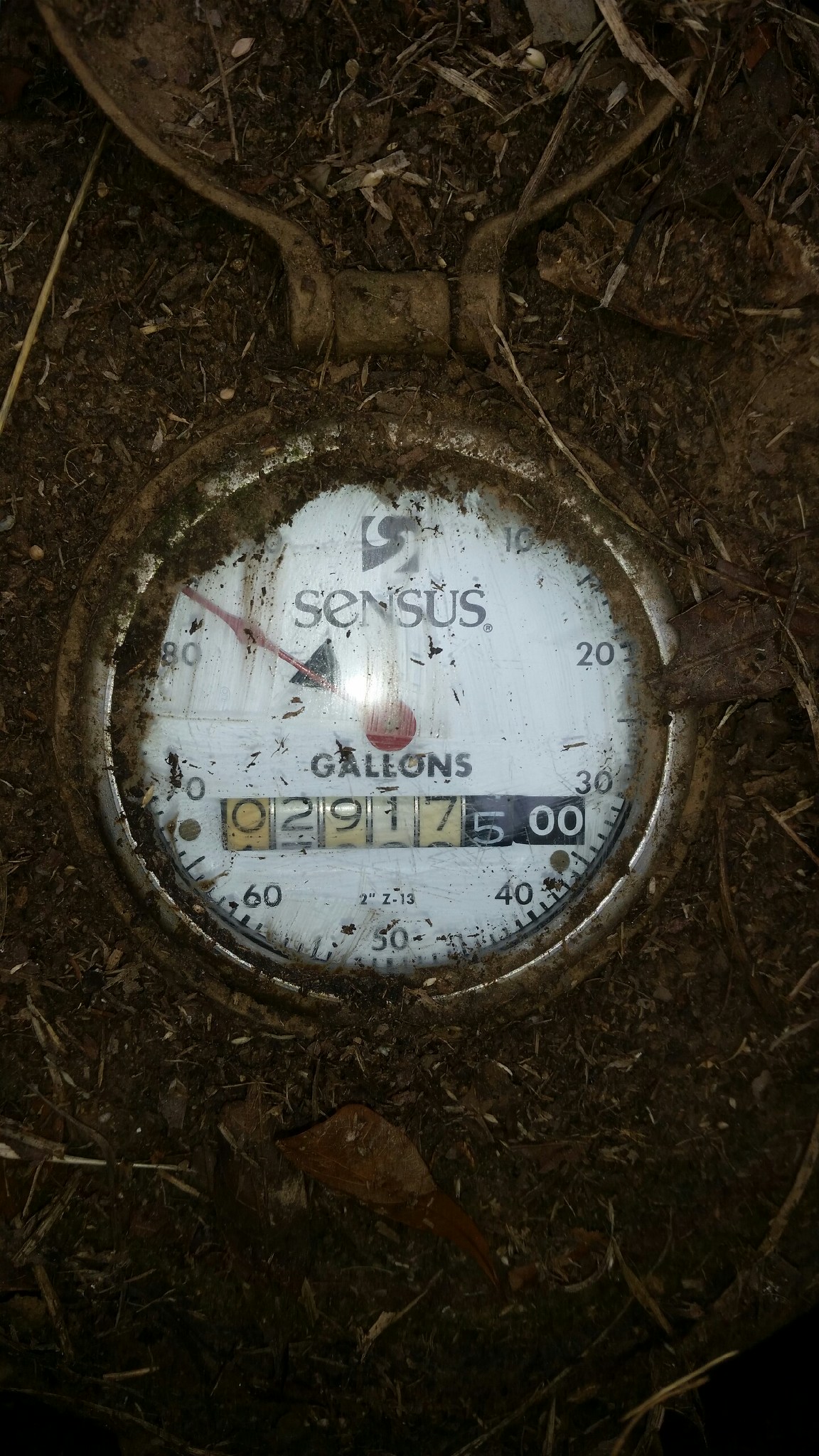
Your meter is usually located within 30 feet of the edge of the street near your home or business in a plastic box in your lawn labeled WATER. The water line between the meter and house often connects to the house near where an external hose spigot is visible. Meter boxes are often occupied by spiders, snakes, moles, and other critters. To protect yourself while checking your meter, put on gloves and insert a tool such as a screwdriver in the hole and pry up the lid. To read the meter, you may have to lift its smaller cover as well, and wipe dirt from the glass lens as required. Read and record the digits from left to right, just like the odometer of a car. Most meters record tens of gallons, not gallons, so the reading will need to be multiplied by 10 to be gallons. The office knows what type of meter you have and can interpret the reading for your. If you have not read your meter before, it is a good idea to record the meter serial number as well to make sure you have your meter and not your neighbors. The meter number can be found on its small lid, and is also etched into the brass of the outlet plenum.

If you received an automated phone, text, or email alert warning of planned maintenance, this is likely the cause, and it will be temporary. Otherwise, the mostly common cause of an unplanned outage or loss of pressure is a leak. If able, check your meter, yard, and neighborhood for signs of a leak. Unusual damp spots on the ground or water in a ditch are common indications. Anytime you suspect a leak, even if pressure is good, please report it to the Office. Leaking water is lost money, and a small leak will only become bigger with time. The fastest way to get an answer and assistance is always to call the Office at 601-681-6157. For a non-urgent problem, you may send an email or use our web Trouble Report.